The Real Footprint — Smaller Than Most People Assume
"I don't have the room" is the most common reason people rule out fruit trees and berry bushes before ever checking the actual numbers. A standard, full-size apple tree does need 25–35 feet of space and genuinely isn't realistic for most residential lots — but almost nobody plants standard trees anymore. Dwarf varieties, grafted onto dwarfing rootstock, mature at roughly 8 to 10 feet tall and wide — smaller than most backyard trampolines, and easily tucked along a fence line, in a side yard, or in a corner that's otherwise doing nothing.
That "recommended spacing" number you see on a plant tag or nursery listing — say, 10 feet for a dwarf apple — refers to the diameter of the mature canopy, not the space between two separate planting holes stacked on top of each other. A single dwarf tree planted by itself needs a circle that size around it, with the trunk at the center; it does not need 10 feet of clearance on every individual side beyond that. Most suburban backyards, even modest ones, have at least one or two spots that size sitting unused.
🌡️ Find Your Cold Hardiness Zone First
Before choosing a single variety, find your USDA Plant Hardiness Zone — it determines which fruit trees and berry varieties will actually survive winter where you live, and matters just as much as available space. The current map (updated in 2023, based on 30 years of weather data) divides the country into 13 zones by average annual minimum winter temperature.
✅ Look up your exact zone in under a minute: Visit the official USDA Plant Hardiness Zone Map and enter your zip code — it gives an exact zone (e.g., 7a, 8b, 9a) down to a half-mile resolution. Every fruit tree and berry bush sold by a reputable nursery lists a hardiness zone range on the tag (e.g., "Zones 5–8"); if your zone falls within that range, the plant should survive your winters without special protection.
Hardiness zone only covers winter cold tolerance — it says nothing about summer heat, humidity, or how many "chill hours" (accumulated cold needed to break dormancy and set fruit) a variety requires. This is exactly where a local Cooperative Extension office earns its keep.
🎓 Your county Cooperative Extension office is the single best free resource for variety selection. The same university-run, research-based service covered on the vegetable gardening and backyard chickens pages publishes free fruit variety recommendations tailored to your specific county — not just your hardiness zone, but local chill hours, common regional pests and diseases, and which named cultivars actually perform well nearby. A phone call or visit to your county Extension office before buying anything is worth more than any general guide, including this one.
🍒 Dwarf Fruit Trees — Real Sizes by Type
Apple
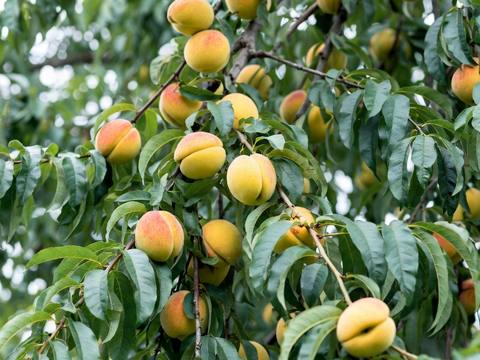
| Mature size | 8–10 ft tall and wide on true dwarfing rootstock (Bud 9, M9, M27). |
| Years to fruit | 2–3 years for first meaningful harvest. |
| Notes | Most apples need a second variety nearby for pollination — a neighbor's tree often counts if it's within bee-flying distance. |
Pear
| Mature size | 8–10 ft tall, but only 6–7 ft wide — pears grow upright and narrow rather than spreading. |
| Years to fruit | 3–4 years typically. |
| Notes | The narrowest-footprint common fruit tree — a good fit for a tight side yard. |
Peach & Nectarine
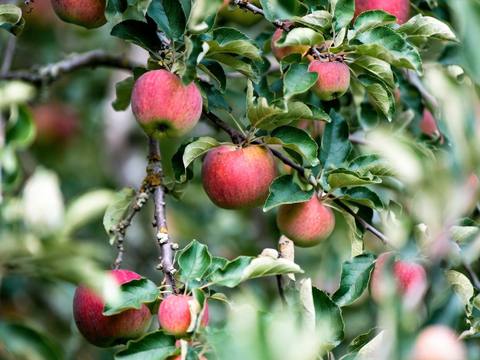
| Mature size | 8–10 ft on dwarf rootstock. |
| Years to fruit | 2–3 years — among the fastest fruiting of common dwarf trees. |
| Notes | Self-fruitful — one tree alone will produce a full crop, no second tree needed. |
Plum
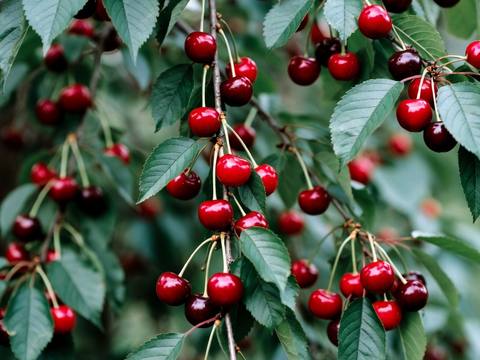
| Mature size | 8–10 ft tall and wide on dwarfing rootstock. |
| Years to fruit | 2–3 years. |
| Notes | Many European plum varieties are self-fruitful; Japanese-type plums generally need a second variety nearby for pollination. |
Cherry (Dwarf Sweet)
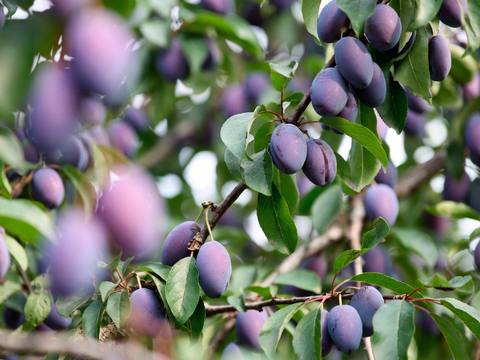
| Mature size | 10–12 ft tall and wide for dwarf sweet cherry — the largest footprint of the common dwarf fruit trees, but still a fraction of a standard cherry's 30–35 ft spread. |
| Years to fruit | 3–4 years. |
| Notes | Most sweet cherries need a second compatible variety for pollination; genetically dwarf "self-fertile" varieties like Stella avoid this requirement. |
Citrus (Dwarf)
| Mature size | 6–8 ft tall and wide for dwarf lemon, lime, orange, and grapefruit. |
| Years to fruit | 2–3 years in-ground; container-grown citrus can fruit even sooner. |
| Notes | Self-fruitful and one of the most container-friendly dwarf fruit trees — can be brought indoors in colder climates over winter. |
Fig
| Mature size | 6–10 ft tall and wide depending on variety and pruning. |
| Years to fruit | 1–2 years — figs are among the fastest fruit-bearing trees available. |
| Notes | Self-fruitful, tolerant of poor soil, and easy to keep smaller with annual pruning if space is especially tight. |
📐 A simple rule of thumb: For spacing purposes, assume a dwarf tree's mature width equals its recommended spacing — an 8-foot-wide tree needs roughly an 8-foot circle. Multiple dwarf trees in a row need that same number between trunks (e.g., two 8-foot dwarf apples need about 8 feet between them, not 16).
🌳 Got Even Less Room? Espalier Takes Almost Nothing
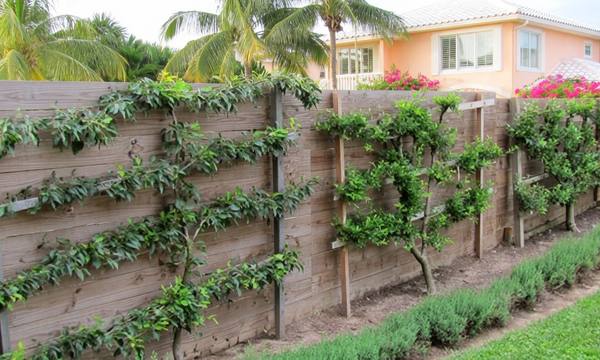
If even an 8-foot circle feels like more than you have to spare — a narrow side yard, a strip along a property line, a fence that's otherwise doing nothing — there's a centuries-old solution that shrinks a fruit tree's footprint down to almost nothing: espalier. The tree is trained flat against a fence or wall, with its branches tied to horizontal wires or a simple wood lattice as it grows, instead of being allowed to spread outward in every direction. The result, as the photo above shows, is a tree that takes up only a few inches of depth from the fence line while still covering 10, 15, or more feet horizontally — and still producing a genuinely full harvest of fruit.
What It Actually Takes
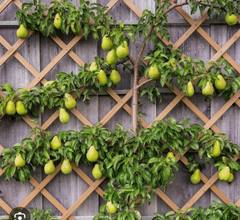 Espalier is a patience project, not a weekend one — a young tree is gradually trained over 3 to 5 years, with branches selected and tied to a support structure as they grow and unwanted growth pruned away each season to keep the flat shape. The payoff is real: once established, an espaliered tree needs only routine seasonal pruning to maintain its form, and as the photo here shows, a mature espaliered tree can carry a genuinely heavy crop — the flat training shapes where the fruit grows, not how much of it. Many espaliered fruit trees remain productive for decades, same as any other dwarf tree, just trained into a shape that fits where a normal tree never could.
✅ Best candidates for espalier: Apples and pears take to espalier training most readily and are the traditional choice, but peaches, plums, and figs can all be trained this way too. A south- or west-facing fence gets the most sun and produces the best harvest. Start with a young, unbranched "whip" tree from the nursery rather than one that's already grown its mature branch structure — it's much easier to train branches from the start than to reshape an established tree.
For someone planting at 50 with the time and patience to invest in the training years, espalier turns a fence line that was contributing nothing into a genuine source of fruit — without sacrificing a single square foot of usable yard space.
🫐 Blueberries & Blackberries — Even Smaller Footprints
Blueberries
| Mature size | 4–6 ft tall, 3–4 ft wide for standard highbush varieties; half-high/dwarf cultivars stay under 3 ft wide. |
| Spacing | 4–5 ft apart center-to-center for individual bushes; plant 3–5 bushes together for best pollination and yield. |
| Notes | Need acidic soil (pH 4.5–5.5); a raised bed or amended soil pocket solves this in most yards. Fits naturally along a fence line as an edible hedge. |
Blackberries (Erect/Thornless, Trellised)
| Mature size | 3–6 ft tall, 3–4 ft spread when trellised and pruned — trailing varieties need 6–8 ft and more room to sprawl. |
| Spacing | 3–4 ft between erect/thornless plants in a row; one simple wire trellis along a fence supports a whole row. |
| Notes | A single mature plant can produce 10–20 lbs of fruit a year. Thornless varieties make harvesting dramatically easier than wild brambles. |
✅ The fence-line trick: Both blueberries and trellised blackberries work well planted in a single row along an existing fence or property line — space that's otherwise doing nothing. A 15-foot stretch of unused fence line comfortably fits 3 blueberry bushes or 4 trellised blackberry plants, no dedicated garden bed required.
🍓 Strawberries — The Smallest Footprint of All, Grown Vertically
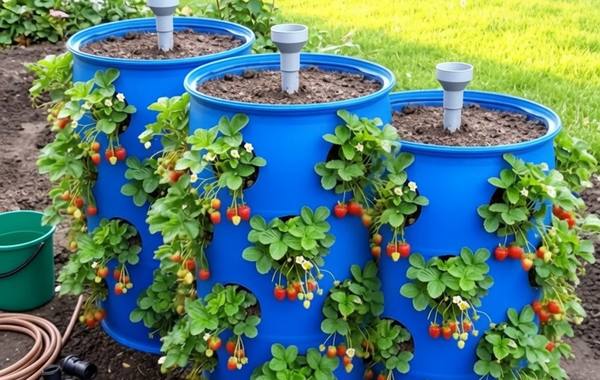
Strawberries grow at ground level and spread, which normally means a dedicated bed — but they're also the one fruit on this page that adapts naturally to vertical growing, and the payoff is dramatic. A single repurposed barrel with holes cut into the sides, like the ones pictured, can hold 20–25 plants in a footprint of just 2–4 square feet — the rough equivalent of a 25-foot traditional garden row, standing upright instead of sprawling across the yard. Three barrels like this comfortably produce more strawberries than most households can eat fresh.
Why a Barrel or Tower Beats a Ground Bed
- Far less bending. Strawberries planted in the ground mean kneeling at soil level to weed and pick; a barrel or tower brings the plants up to a comfortable standing or seated height, the same ergonomic logic as a raised garden bed.
- Cleaner fruit, fewer pests. Berries hang off the side of the barrel rather than sitting on damp soil, which means less rot, less slug damage, and less mud on the fruit itself.
- Easy to water. A center column of gravel or a simple pipe down the middle, watered from the top or fed by a drip line, reaches every plant in the barrel at once.
✅ Building one is a weekend project, not a major expense. A food-safe plastic barrel, a hole saw or jigsaw to cut planting openings, and a bag or two of quality potting soil is most of the cost. Pre-made vertical strawberry towers and planters are also widely available if building one isn't appealing.
Beyond Fresh Eating: Jam & Jelly
A productive strawberry barrel often produces more fruit at once than a household can eat fresh, especially with June-bearing varieties that ripen in one concentrated flush rather than trickling in all season. That surplus is exactly what jam and jelly were invented for — a practical, traditional way to preserve a big harvest so nothing goes to waste, and a homemade jar of strawberry jam costs a fraction of what the equivalent costs at the store. Proper water-bath canning technique matters for food safety; your county Cooperative Extension office, the same free resource covered earlier on this page, typically publishes tested, safe jam and jelly recipes and canning guidelines specific to home preservation.
🪴 No Yard at All? Containers Still Work
If even a small in-ground footprint isn't available — a condo patio, a small deck, a mostly-paved lot — dwarf citrus, fig, and even some dwarf apple varieties grow successfully in large containers (15–20+ gallon pots). Container growing sacrifices some ultimate size and yield compared to an in-ground tree, but it's a genuine option, not a compromise that fails to produce. Citrus in particular is one of the most reliable container fruit trees, and in colder climates a potted citrus tree can be moved indoors for winter, something an in-ground tree can't do.
💧 The Drip Irrigation Solution — For When You Forget, or Just Don't Have Time
Young fruit trees and newly planted berry bushes are the most vulnerable to missed watering in their first one to two years, and a missed week during a hot, dry stretch is the single most common reason a new planting fails. The fix isn't more willpower or a better memory — it's removing watering from the list of things that depend on either one. A simple drip irrigation system on an inexpensive mechanical timer waters automatically on a schedule, whether you remember, whether you're traveling, or whether gardening chores just slip down the priority list during a busy week.
What a Basic Setup Actually Looks Like
- A drip line or soaker hose run to the base of each tree or along a row of berry bushes, delivering water slowly and directly to the root zone rather than spraying it overhead where much of it evaporates.
- A battery-powered mechanical timer that screws onto an outdoor spigot ($15–$30) and opens the water on a set schedule — no wiring, no app, no smart-home setup required. Set it once and it runs without you thinking about it again.
- Drip emitters or a soaker hose loop at each plant, sized to the plant's needs: young trees typically need a deep watering once or twice a week rather than a daily light sprinkle, which actually encourages deeper, more drought-resistant root growth.
✅ Why this matters more for trees and berries than vegetables: A vegetable bed that misses a week of water shows it immediately and can often recover the next season. A young fruit tree or berry bush that dries out at the wrong moment in its first year or two can die outright, losing the multi-year head start toward fruiting that's the whole point of planting a dwarf variety in the first place. The $30–$50 cost of a basic drip timer setup is cheap insurance on a planting meant to produce for the next 15–20 years.
Once a tree or bush is established (after roughly its first two seasons), root systems are deep and resilient enough that occasional missed watering becomes far less risky — the drip system mostly earns its keep in those critical early years, then continues paying off every summer afterward in convenience and consistency.
Drip Irrigation Kits on Amazon →🧰 What Else You'll Actually Need
Watering gets most of the attention, but a handful of other inexpensive items make the difference between a tree or bush that struggles and one that thrives — all one-time or once-a-year purchases, not ongoing chores.
Mulch
A 2–4 inch layer of mulch (wood chips, shredded bark, or straw) around the base of every tree and bush — kept a few inches back from the trunk itself — does double duty: it holds soil moisture between waterings, which matters even more with a drip system, and it suppresses competing weeds and grass that would otherwise steal water and nutrients from young roots. Refresh it once a year; it's one of the cheapest, highest-payoff things on this list.
Tree Stakes & Trunk Protection
A newly planted dwarf tree often needs a simple stake and soft tie for its first year or two, until the root system is established enough to hold the tree upright on its own in wind. A plastic spiral trunk guard or hardware-cloth wrap around the base also protects young, thin bark from rabbits, voles, and lawn-trimmer damage — a surprisingly common way young trees get girdled and killed in their first winter.
Fertilizer
A balanced, slow-release fruit tree fertilizer applied once in early spring covers most dwarf trees' needs for the year. Blueberries are the exception — they need an acid-forming fertilizer formulated for acid-loving plants (the same type used for azaleas and rhododendrons) to maintain the low soil pH they require.
Bird Netting
Birds will often find ripening blueberries and cherries before you do. A simple net thrown over the bush or tree at the first sign of color change is the standard, low-cost fix — not required, but worth having on hand if you don't want to share the entire harvest with the local bird population.
Basic Pruning Tools
A pair of bypass hand pruners handles most annual maintenance pruning; loppers help with anything thicker than finger-width. The same quality-over-cheap logic from the vegetable gardening guide applies here — a well-made pair of pruners lasts decades, while a cheap pair dulls fast and crushes rather than cleanly cuts branches, which slows healing and invites disease.
✅ None of this is a recurring chore. Mulch once a year, fertilize once a year, prune once a year in late winter while the tree is dormant. Outside of those few annual tasks and whatever the drip system handles automatically, a mature dwarf tree or established berry bush mostly takes care of itself.
Plant at 50, Pick Fruit Well Into Your 70s
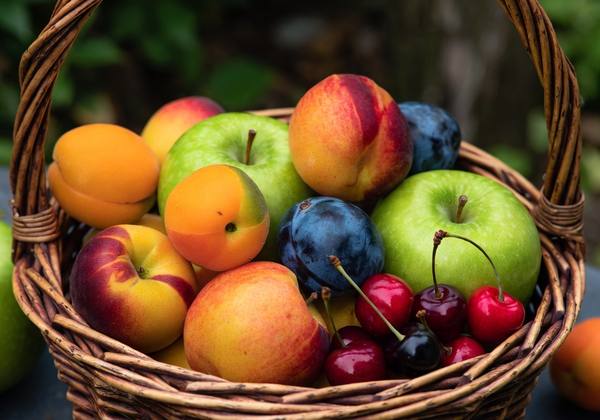
This is the same logic that applies to the garden kneeler bench and the chicken coop, just on a longer timeline: a dwarf fruit tree or berry bush is infrastructure you plant once and that keeps producing, with almost no ongoing cost, for 15 to 20+ years. The window between 50 and 70 is exactly the stretch where that timeline pays off completely — plant at 50, eat the first real harvest by 53, and still be picking fruit from the same tree at 70 without having done anything more than basic annual pruning.
📅 Don't wait for "someday." The single biggest mistake is treating fruit trees as a someday project. A tree planted today is 2–3 years closer to its first harvest than the same tree planted three years from now. There's no real cost to planting now — a dwarf tree or berry bush is a one-time purchase of $25–$60 and an afternoon of digging, not an ongoing commitment like livestock.
🔧 Don't cheap out on the rootstock or the source. Buy bare-root or container trees from a reputable nursery that discloses the rootstock (true dwarfing rootstock like Bud 9 or M9 for apples, not a seedling that will eventually outgrow its space), rather than an unmarked big-box discount tree. A few extra dollars for a tree with known, documented rootstock is what guarantees it actually stays the size you planned for.
Dwarf Fruit Trees →🖨️ Printable Yard Space Planner
Print this and walk your yard with it — most people are surprised how many of these actually fit once they measure rather than guess.
Before You Plant
Dwarf Fruit Trees
Blueberries & Blackberries
Strawberries
Other Supplies
💬 What Happens When You Plant at 55 and Harvest at 60
“We planted two dwarf apple trees and a peach the year I turned 56. My wife thought we were crazy. Our yard is not large. But they were small trees and we had a fence line doing nothing. I will not lie — the first two years were not impressive. Small fruit, not much of it. By year four those trees were producing more than we could eat. We started leaving bags of apples on the porches of three neighbors who we knew were on fixed incomes. One of them, a woman in her late seventies, told me it was the first fresh fruit she had eaten in months because the price at the store had gotten so high. That stopped me. I had planted those trees thinking about pies. I had not thought about what it means to have more than you need when someone nearby has less.”
“I planted three blueberry bushes when my youngest left for college. That was twelve years ago. Last summer I picked forty-two pounds of blueberries from those three bushes. Forty-two pounds. I made jam. I froze bags. I brought them to church. I sent my kids home with quart bags every time they visited. My granddaughter, who is seven, sat in the yard and ate blueberries directly off the bush for an entire afternoon and I did not say a word. That is the kind of grandmother I wanted to be. I spent about thirty dollars on those three bushes in 2012. I cannot calculate what they have given back since then. I have stopped trying.”
“My father planted a fig tree in our backyard when I was a child. I grew up thinking it was just something that was there. When he died I inherited the house and that fig tree was forty years old. The thing produced figs every summer like a factory. My kids grew up eating figs out of that yard the same way I did. My grandkids eat figs out of that yard now. No one in this family has ever bought a fresh fig from a store. My father planted that tree and it is still feeding people three generations later. I planted two more the year I turned sixty so someone can say that about me someday too.”
“I have rheumatoid arthritis. Traditional gardening has not been possible for me for years. But a dwarf fruit tree in a large container on my patio requires almost nothing — water it, fertilize it once in the spring, and get out of its way. I have a dwarf Meyer lemon and a dwarf key lime in pots on my back patio. They have been there for six years. I make lemon curd. I make key lime pie. I bring both to my daughter’s house at Christmas and my son-in-law says it is the only dessert he actually looks forward to all year. I am 71 years old with hands that do not work the way they used to, and I grow the lemons for the best pies my family has ever eaten. Nobody sees that coming. I love that nobody sees that coming.”
“Fresh fruit is expensive. I do not think people who are not on a fixed income fully understand how expensive it has gotten. A bag of apples. A pint of strawberries. A box of blueberries. These are not luxuries but they cost like luxuries now. My grandchildren love fruit. They are five and eight and they will eat fruit until it is gone if you put it in front of them. I planted three blueberry bushes and two dwarf apple trees seven years ago when my youngest granddaughter was not yet born. Last summer those bushes and those trees gave my grandchildren more fruit than they could eat in three weeks of visits. I sent bags home with their parents. I made apple butter. I froze blueberries in bags they can thaw all winter. I planted those trees thinking about a quiet retirement. They turned out to be for the grandchildren I did not have yet.”
“My grandson asked me last summer where fruit comes from. He is six. He did not know. He thought it came from the grocery store, which I suppose it does when you live in an apartment in a city. I took him out to the backyard and showed him the peach tree I planted eight years ago. I let him pick a ripe peach off the branch and eat it standing there in the yard. He looked at me like I had performed a magic trick. We spent the rest of that afternoon picking peaches and making a cobbler together. He stirred the filling and I handled the oven. He ate three servings. He went home and told his parents that Grandpa has a peach tree and they make cobbler from it. His father called me that night and asked how hard it was to grow a peach tree. I told him to come over and I would show him. He came the following Saturday. We planted two more trees together. That is how this works.”
Most dwarf fruit trees mature at 8 to 10 feet tall and wide, meaning a single tree needs roughly an 8 to 10 foot diameter circle of space, with the trunk at the center. That is small enough to fit along a fence line, in a corner of an average backyard, or even in a large container on a patio. Citrus dwarfs run slightly smaller, closer to 6 to 8 feet, while dwarf pears stay narrower still, around 6 to 7 feet wide despite reaching 8 to 10 feet tall.
How long does it take a dwarf fruit tree to produce fruit?
Dwarf fruit trees typically bear their first meaningful fruit in 2 to 3 years, faster than semi-dwarf (3 to 4 years) or standard full-size trees (4 to 6 years), because dwarfing rootstock pushes the tree toward fruit production sooner rather than spending years on vegetative growth. A dwarf tree planted at 50 is usually producing full harvests well before 55, and many dwarf fruit trees remain productive for 15 to 20 years or more.
How much room do blueberry and blackberry bushes need?
A mature blueberry bush needs roughly 3 to 4 feet of width, so plants are typically spaced 4 to 5 feet apart center to center. Blackberries vary by growth habit: erect and semi-erect varieties need about 3 to 4 feet between plants, while trailing varieties grown on a trellis need 6 to 8 feet. Both can be planted in a single row along a fence line or property edge rather than needing a dedicated garden bed.
How do I know if a fruit tree or berry bush will survive my winters?
Look up your USDA Plant Hardiness Zone at planthardiness.ars.usda.gov by entering your zip code, then compare it to the zone range listed on the plant tag (for example, "Zones 5-8"). If your zone falls within that range, the plant should reliably survive winter in your area. Hardiness zone covers winter cold tolerance only, not summer heat or chill-hour requirements for fruiting, so a local Cooperative Extension office is the best free resource for variety recommendations specific to your county.
What if I forget to water or don't have time to tend a new tree?
A simple drip irrigation line on a battery-powered mechanical timer ($30-50 total) solves this completely — it waters automatically on a set schedule without requiring you to remember, regardless of travel or a busy week. This matters most in a tree or bush's first 1-2 establishment years, when a missed watering during a hot, dry stretch is the leading cause of a new planting failing outright. Once established, root systems become deep and resilient enough that occasional missed watering is far less risky.
What is espalier and how much space does it actually need?
Espalier is a centuries-old technique where a fruit tree is trained flat against a fence or wall, with branches tied to horizontal wires or a lattice as the tree grows, rather than spreading outward in every direction. An espaliered tree takes up only a few inches of depth from the fence line while still covering 10 feet or more horizontally and producing a full harvest. It takes patience to train, typically 3 to 5 years of seasonal pruning and tying before the shape is fully established, but apples and pears in particular take to it readily and remain productive for decades once trained.
What else do I need besides the tree or bush itself?
A handful of inexpensive, mostly one-time items: mulch (refreshed once a year) to hold moisture and suppress weeds, a stake and soft tie for a young tree's first 1-2 years, a trunk guard to protect thin young bark from rabbits and lawn trimmers, a balanced fertilizer applied once each spring (an acid-forming type specifically for blueberries), bird netting if birds compete for blueberries or cherries, and a quality pair of bypass pruners. None of these are ongoing chores beyond a once-a-year application.
How much space do strawberries actually need?
Grown in the ground, strawberries spread and typically need a dedicated bed, but they adapt unusually well to vertical growing. A single repurposed barrel with planting holes cut into the sides can hold 20 to 25 plants in a footprint of just 2 to 4 square feet, roughly equivalent to a 25-foot traditional garden row. This also raises the plants to a comfortable working height, reduces rot from fruit sitting on damp soil, and makes a barrel or tower one of the most space-efficient food-producing options for a small backyard.
📚 Primary Sources & Official Data
- • University of Maine Cooperative Extension — Fruit Tree Spacing Guidelines
- • UF/IFAS Gardening Solutions — Blueberries
- • NC State Extension — Blackberries for the Home Garden
- • USDA Plant Hardiness Zone Map (2023 edition)
- • Find your county's Cooperative Extension office →
Page last reviewed: June 2026 | Author: Franklyn Galusha