The Night the Grid Gave Out
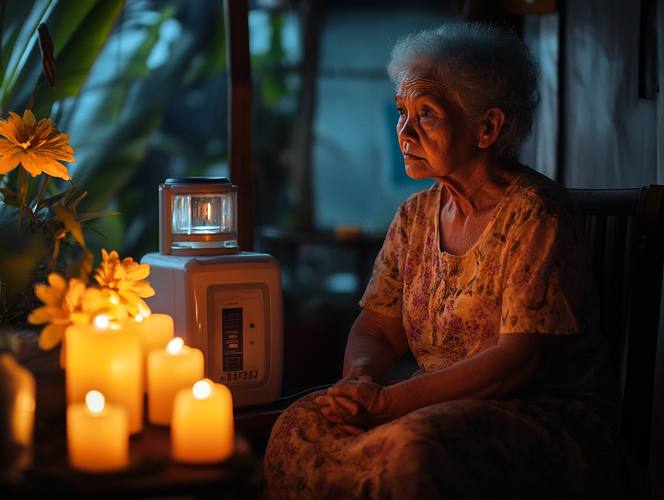
Carmen was 71 years old, a retired bank teller who had lived in the same San Juan apartment for over thirty years. She had been on supplemental home oxygen for four years following a diagnosis of chronic obstructive pulmonary disease. Her oxygen concentrator ran continuously, day and night, pulling room air and concentrating it into the stream that kept her breathing comfortably. She had grown so used to its hum that she said she only noticed it when it stopped.
Puerto Rico's electrical grid had been fragile for years — the legacy of Hurricane Maria's destruction in 2017 was still visible in patched transmission lines and an aging distribution system that utility engineers had warned, repeatedly, was operating well past its design life. Carmen had lived through enough partial outages to develop a casual relationship with the unreliability. The power went out. It usually came back within a few hours. She had never treated it as a planning problem.
On a Tuesday night in late summer, a transmission failure cascaded across a significant portion of the island's grid. The outage was not storm-related — no hurricane, no named event, nothing that would have triggered evacuation warnings or generated advance notice. A piece of aging equipment failed during a period of high demand, and the failure rippled outward faster than operators could isolate it. Hundreds of thousands of customers lost power simultaneously, including Carmen's neighborhood.
Her oxygen concentrator stopped at 11:42 PM. Her backup — a small portable oxygen tank she kept beside her bed for exactly this situation — had enough supply for approximately three days at her prescribed flow rate. She did not know, at that moment, that the outage would last eight.
"I heard the machine stop and I lay there in the dark counting my own breathing. I had three tanks. I did the math in my head before I even turned on a flashlight. Three days. I remember thinking, surely it will not take three days."
The Oxygen Math That Changes Everything
A portable oxygen tank's duration depends entirely on flow rate. Carmen's physician had prescribed 2 liters per minute continuous flow. At that rate, a standard portable cylinder lasts a predictable, calculable number of hours — information her pulmonologist's office had given her on a printed sheet years earlier, which she still had taped inside a kitchen cabinet.
Three tanks at her flow rate gave her approximately 72 hours, assuming no waste, no interruption, and careful rationing. She immediately began conserving — sitting rather than moving around her apartment, avoiding any activity that increased her breathing demand, sleeping with the flow rate at the lowest setting her doctor had approved for rest.
What Carmen did not have was a fourth tank, a way to refill the tanks she had, or — critically — a generator or battery system capable of running her electric concentrator, which would have made the portable tanks unnecessary entirely. She had backup oxygen. She did not have backup power. The distinction would define the next eight days.
⚠️ What Most Seniors on Home Oxygen Get Wrong
The Fight Nobody Wanted to Have
Two months before the outage, Carmen's daughter Isabella, who lived forty minutes away in Bayamón, had pushed her mother to buy a small battery backup system sized specifically to run her oxygen concentrator through an extended outage. Carmen had refused. The cost was approximately $900 for a battery station with sufficient capacity, and Carmen, on a fixed pension, considered it an unnecessary expense for a problem she did not believe would happen to her.
Isabella did not let it go. She had grown up watching her mother manage her health with quiet, stubborn independence, and she recognized in that same stubbornness a real risk. After her mother's third refusal, Isabella made a decision her mother explicitly did not approve of: she bought the battery station herself, had it delivered to her mother's apartment, and set it up without further discussion, treating it as a gift rather than a debate to be reopened.
Carmen was, by her own later account, irritated. She felt her independence had been undermined. She left the unit in its box in a closet for several weeks, unused, a small act of quiet protest against her daughter's intervention.
"I told Isabella I did not need it. I told her three times. She did not argue with me about it — she just bought it anyway and set it up while I was at church. I was angry about that for a while. I am not angry anymore."
When the grid failed and Carmen's three days of portable oxygen began counting down, the battery station was still sitting, fully charged from its initial setup, in the corner of her bedroom where Isabella had positioned it. On the morning of day two, with one portable tank remaining and panic finally overtaking pride, Carmen connected her concentrator to the battery system her daughter had insisted on. It ran without interruption for the remainder of the outage.
Eight Days: What the Battery Made Possible
The battery station Isabella had purchased was a 1,500Wh portable power station — mid-sized, designed for exactly this kind of medical backup use rather than whole-home power. Carmen's oxygen concentrator drew approximately 350 watts during operation. At that draw, a full charge gave her roughly four hours of continuous runtime before requiring a recharge.
This created a new problem: the battery itself needed power to recharge, and the grid remained down. Isabella, once she learned her mother was using the unit, began driving to Carmen's apartment daily with a small generator borrowed from a neighbor, running it on the apartment building's shared courtyard for two hours each morning to fully recharge the battery station before returning to her own household responsibilities forty minutes away.
This routine — imperfect, exhausting for Isabella, but completely effective — sustained Carmen's oxygen supply for the full eight days of the outage. She never returned to portable tanks after day two. Her concentrator ran every night without gaps. Her blood oxygen levels, which she monitored with a pulse oximeter her daughter had also insisted on years earlier, never dropped into a range that concerned her pulmonologist when she finally reached him by phone on day four.
✅ What Made the Difference
Your Plan — Whether Your Family Listens or Not
Carmen's story is not unusual among seniors on home oxygen. Refusing a backup system out of pride, cost concerns, or simple disbelief that a multi-day outage could happen is common — and grid instability is not unique to Puerto Rico. Aging infrastructure, increasing demand, and extreme weather have made multi-day outages a documented reality in nearly every US region.
⚡ The Oxygen Backup Plan Every Senior Should Have
Carmen has since asked Isabella to help her research a whole-home standby generator — large enough to run her concentrator, her refrigerator, and her lights without anyone needing to drive a borrowed generator across town every morning. "I told her I was sorry it took eight days in the dark to listen to her," Carmen said. "She told me she would have rather had the fight than not have the battery. She was right both times."
"My daughter bought that battery against my wishes and I was embarrassed for weeks. Now I tell everyone in my building: if your child or your neighbor is trying to get you a backup system, let them. Being right about not needing help is not worth what almost happened to me."
This story is a composite narrative drawn from documented experiences of home oxygen patients during extended grid failures, including events in Puerto Rico following Hurricane Maria's lasting infrastructure damage and subsequent non-storm grid failures. Names are fictional. Oxygen flow rate and tank duration figures reflect general published respiratory therapy guidance — consult your prescribing physician and home oxygen supplier for guidance specific to your equipment and prescription. For official preparedness guidance for medical equipment users, visit FEMA Ready.gov Senior Preparedness and the CDC Guidance for Respiratory Patients in Disasters.